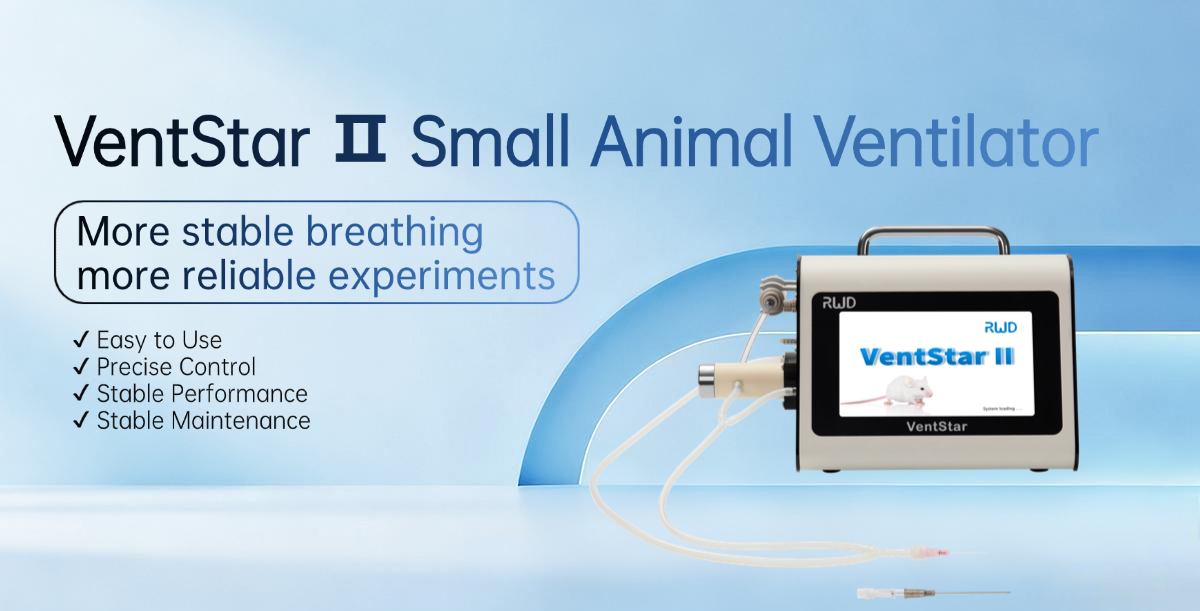
All-New R416 VentStar Ⅱ Small Animal Ventilator – 8 Upgrades for Greater Peace of Mind in Your Experiments
| September 23, 2026
In animal surgical experiments, the ventilator is often the “lifeline” supporting the respiratory function of experimental animals and helping maintain stable ventilation throughout the procedure. Every fluctuation in parameters, every loosened segment of tubing, and every abnormal alarm may affect the course of the experiment — even determine the survival of the animal.
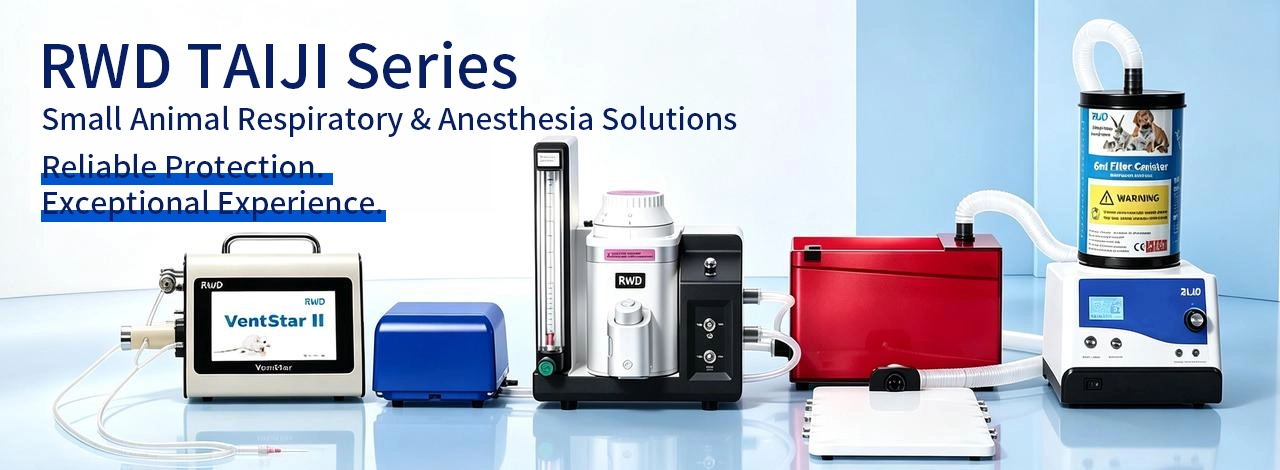
As one of the leading providers of small animal respiratory and anesthesia solutions in China, RWD’s R405, R407, and R415 series small animal ventilators have, since their market launch, earned the trust and recognition of numerous universities, enterprises, and hospitals at home and abroad.
Through ongoing customer feedback and collaboration, RWD has continuously gathered insights, collecting feedback on the user experience of our small animal ventilators, as well as suggestions for improvement, from universities, enterprises, and hospitals alike. This time, we incorporated valuable feedback from our users: targeting the pain points encountered with the R415 in real-world applications, our team carried out a comprehensive upgrade across structure, hardware, software, and accessories — and the R416 VentStar Ⅱ Small Animal Ventilator was born! More stable breathing, more reliable experiments!
Below are the eight core improvements of the R416 compared with its predecessor, the R415. Take a sneak peek:
I. Structure + Hardware Upgrades
01 New PEEP Knob at the Terminal End of the Gas Circuit | More effortless and efficient with every breath
The R416 features a newly added PEEP adjustment knob at the terminal end of the gas circuit, providingshifts PEEP maintenance from software-based setting to physical locking. Compared with the R415, the knob enables fine adjustment of the PEEP level, the waveform bottom can be aligned with the indicator line, ensuring the PEEP value stays more stably at the preset level.
PEEP maintains positive pressure at the end of expiration, helping prevent alveolar collapse and maintain alveolar stability. This can support more consistent ventilation, particularly during prolonged experiments or when working with animals in weaker condition.
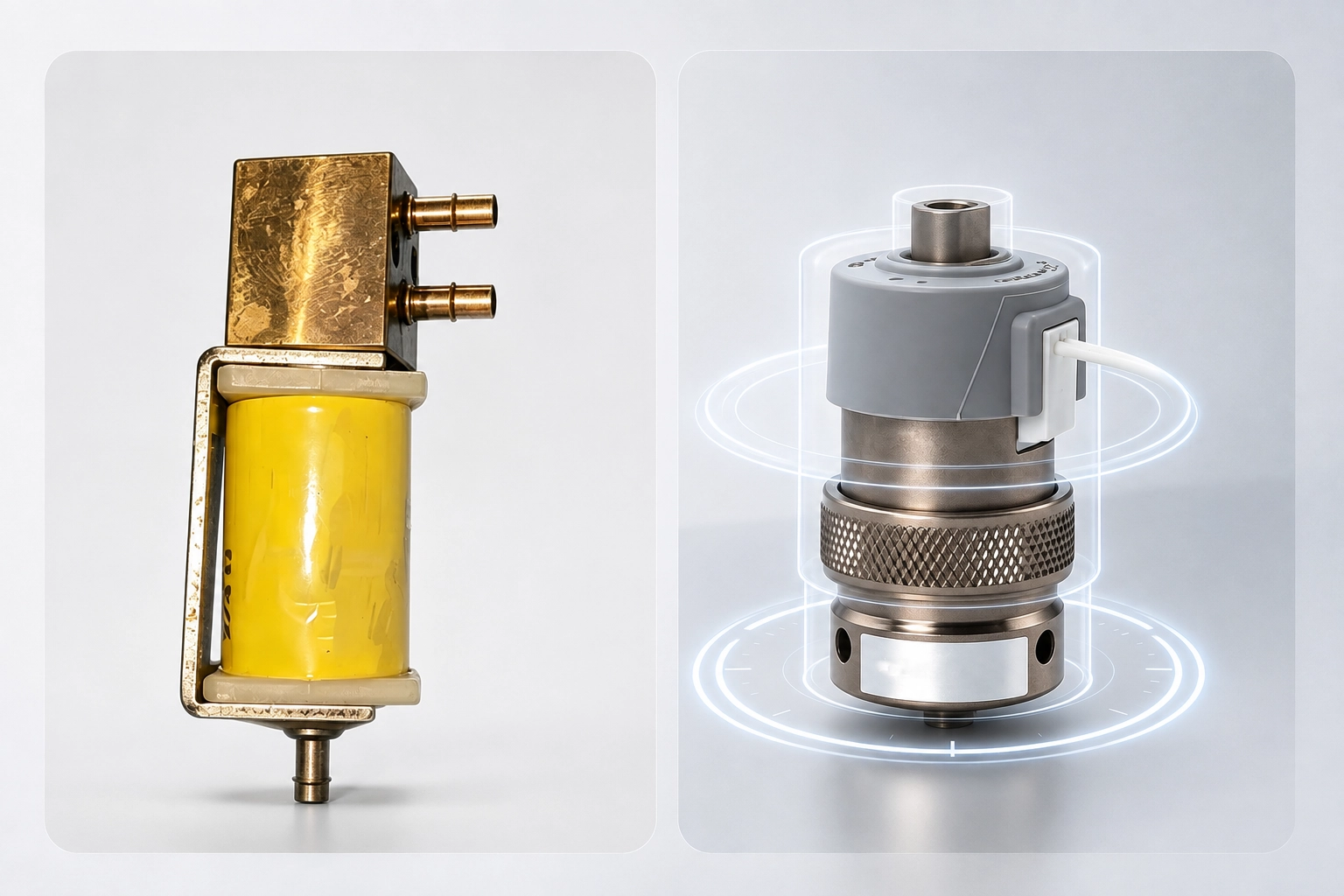
02 Upgraded Solenoid Valve | Quieter and More Durable
The R416 features a fully upgraded solenoid valve, replaced with a new model that is quieter and more corrosion-resistant. According to internal testing, the service life of the R416’s solenoid valve is approximately doubled compared with that of the R415. At the same time, operating noise has been significantly reduced, minimizing disturbance to experimental animals and truly putting animal welfare into practice.
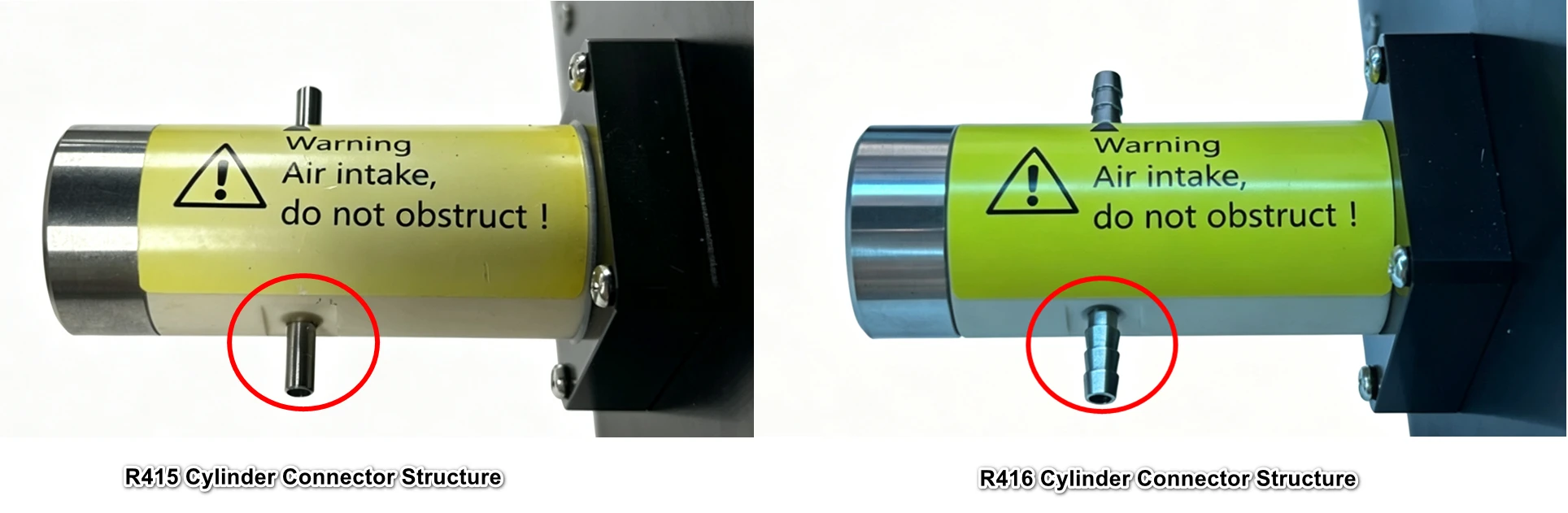
03 Upgraded Cylinder Connector | Enhancing “Gas Supply Stability” at the Source
To make gas supply more stable, the R416 incorporates two key adjustments to the cylinder connector:
Adjusted angle of both ports (outlet end moved upward)
The connector shape changed from flat to barbed
These changes help optimize the gas flow path while providing a more secure and better-sealed connection with the silicone tubing, reducing the risk of gas leakage and improving overall ventilation stability.
II. Software Upgrades
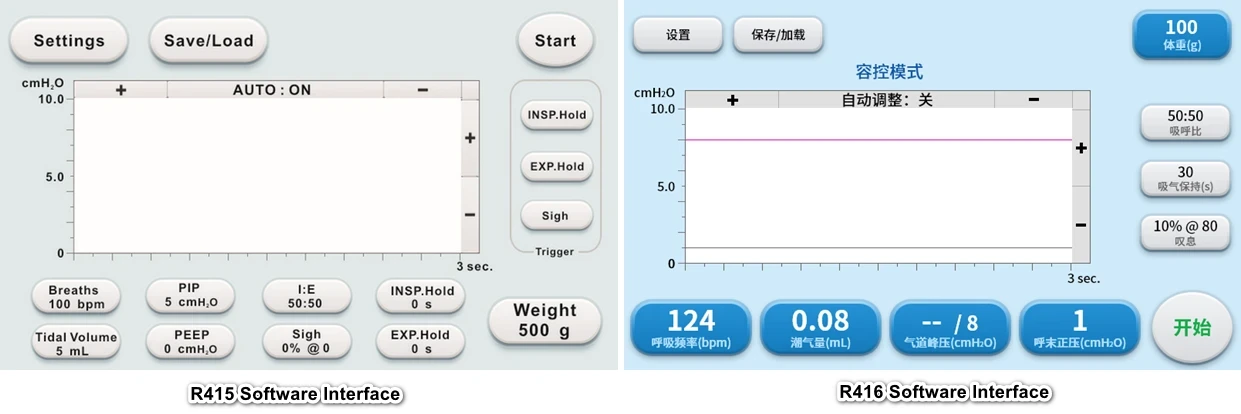
04 A Completely Different Software Interface | Bilingual Chinese-English Interface, Key Information at a Glance
The software interface of the R416 has been systematically redesigned around the principles of “lowering the entry barrier and focusing on what matters”:
Newly added Chinese interface: more user-friendly for domestic users, significantly lowering the entry barrier;
Highlighted key settings: information hierarchy restructured to emphasize critical data, making it easier to focus on the essentials;
Real-time display of peak airway pressure: the animal’s airway status is visible at a glance for timely assessment;
Real-time display of tidal volume in pressure-controlled mode: experimental data recording becomes more convenient and accurate.
A superior interface design is not about showing more information — it’s about letting you see the most important information at a glance, exactly when you need it.
05 Reset Recommended Parameters | Say Goodbye to the Headache of Parameter Tuning
The upgrade of recommended parameters is the most critical part of this iteration. Based on hundreds of experimental tests, RWD has reorganized and refined the built-in recommended parameters of the R416, ensuring they align more closely with real experiments and better support normal breathing in animals. In both pressure-controlled and volume-controlled modes, the animal’s body weight must be entered first; after the device is started, it can be connected to the animal, and the device will automatically apply the recommended parameters, greatly reducing the cost of pre-experiment tuning.
Please note: The built-in parameters are designed to provide an appropriate starting point for ventilation based on the animal’s body weight. However, if during actual experiments you find that the animal still requires supplemental breaths, fine adjustments can be made on this basis. The recommended parameters are a safe starting point, not an absolute end point.
06 New Feature in Pressure-Controlled Mode | Constant Tidal Volume for More Stable Experiments
The R416 introduces a new constant tidal volume function in pressure-controlled mode. Once set, the device can directly maintain the target tidal volume without requiring frequent adjustments during experimental procedures, ensuring stable experiment progress. Meanwhile, the initial tidal volume in pressure-controlled mode is automatically determined based on the animal’s body weight. The motor also responds more quickly, helping the ventilator reach the target peak airway pressure more efficiently and improving the stability of ventilation.
III. Accessory Upgrades
07 Optimized Breathing Circuit | Softer, Safer, More Considerate
The tubing may seem like just an accessory, yet it is the lifeline that connects the device to the animal. The R416 incorporates two key improvements to the tubing:
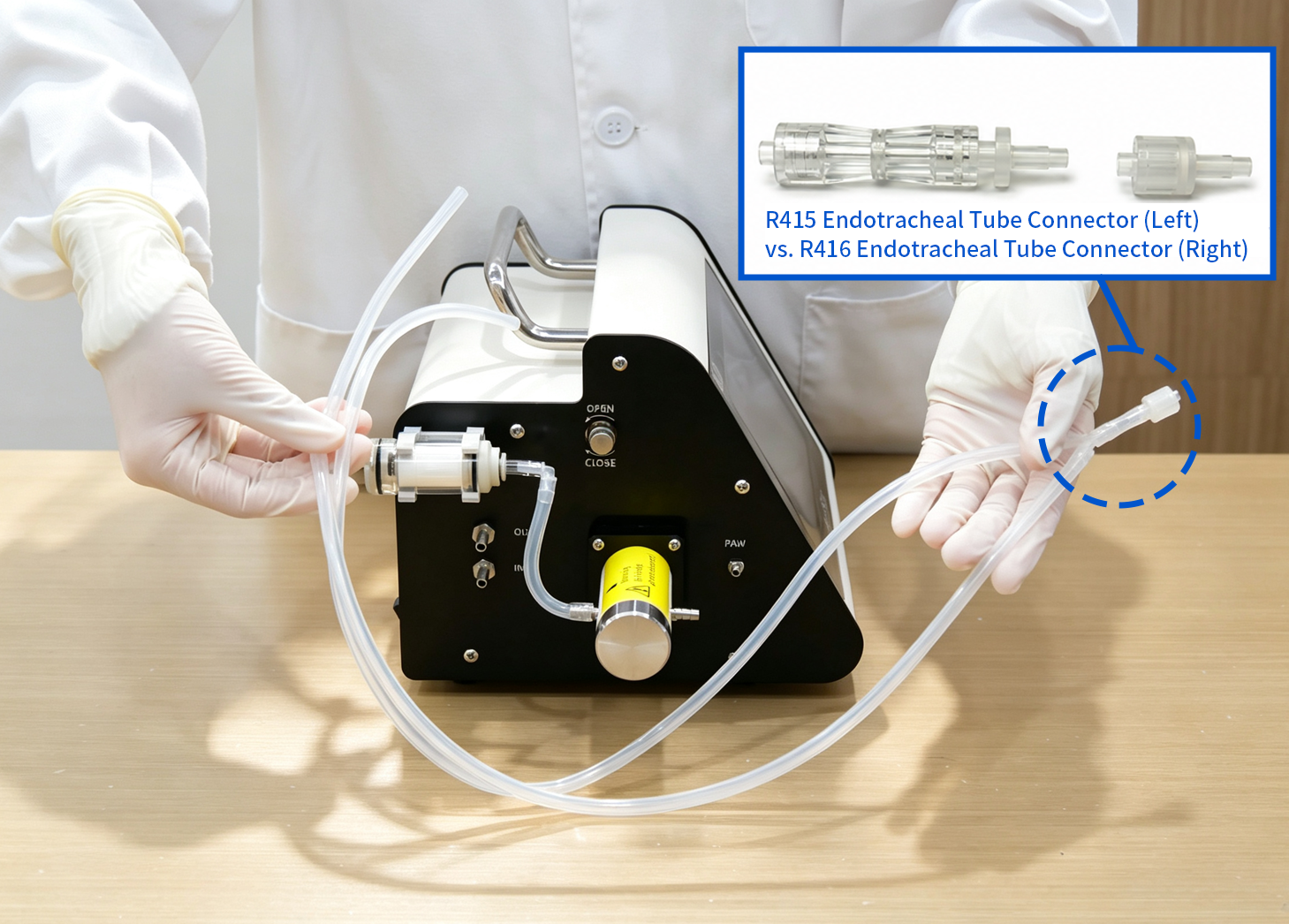
Softer material: Shore hardness adjusted from 60A to 50A, making it easier to secure; when moving the animal, the tubing is less likely to tug on the endotracheal tube, reducing the risk of dislodgement or injury;
Tube connector changed from double-ended to single-ended: dead space is reduced by half, improving ventilation efficiency and avoiding the risk of hypoxia caused by excessive dead space.
In addition, the R416 comes standard with a combined ventilation-and-anesthesia tubing set (R416-AP-AV) — no additional ordering required, ready to use out of the box, and compatible with both injectable and inhalational anesthesia.
08 New Intake Filter | A “Protective Suit” for the Cylinder
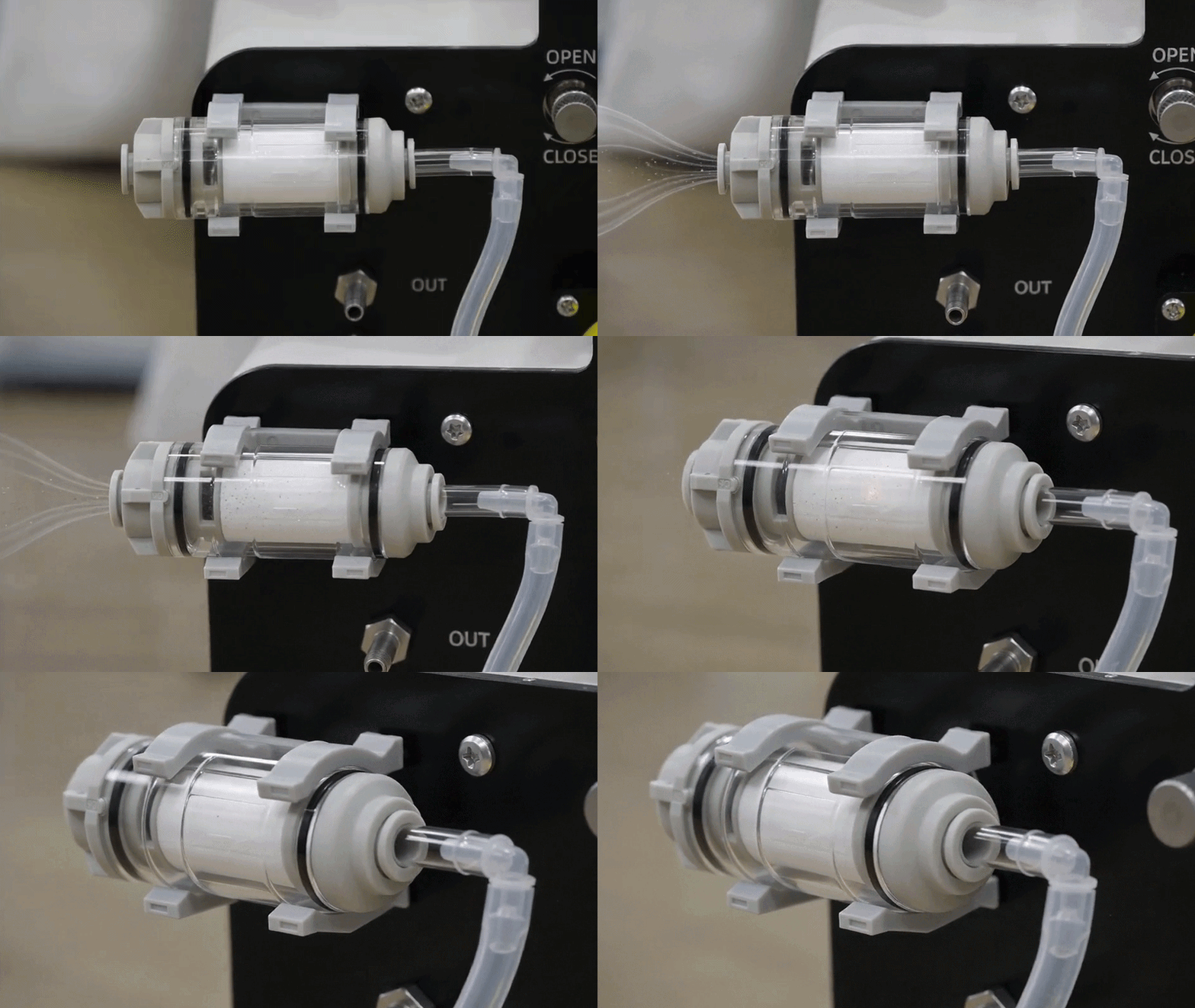
During animal experiments, impurities or foreign matter can enter the cylinder along with the airflow, causing abnormal noise and even damaging the cylinder. The filter intercepts impurities at the air inlet, helping prevent foreign matter from entering the cylinder, reducing the risk of abnormal noise and wear, and extending the device’s service life.
From the R405, R407, and R415 to the R416, over the past fifteen years, what has changed is ever more precise parameters, more stable performance, and friendlier operation; what remains unchanged is RWD’s relentless pursuit of making ventilation “safer, more stable, more precise, and simpler.”
The R416 small animal ventilator is now officially available. We look forward to it becoming the most reliable partner in your laboratory!
1.Fill in the form and our experts will get back to you ASAP!
2.Ask about An Equipment
3.Wondering which equipment to conduct your researches or perform your experiments? Our
sales reps will try their best to share their knowledge with you!
4.Get Technical Support
5.An RWD equipment is not performing? Talk to our support team to get instant feedback!